Smithsonian american women’s history museum
Audience Engagement Strategy for a Brand New Smithsonian Museum
What does it mean to be a truly digital-first museum in the 21st century? How might taking a “virtual museum” approach build strong relationships with diverse global audiences? What role might the Smithsonian American Women’s History Museum play in the lives of audiences and communities across the country and the world?
Originated as a collaboration between two new-at-the-time entities – the Smithsonian American Women’s History Museum (Women’s History), and the Office of Digital and Innovation (ODI) – the “virtual museum” research served two purposes: to support Women’s History in meeting their digital-first mandate with an audience engagement strategy to match; and to derive insights to advance the Smithsonian’s digital capacity, a key part of ODI’s mandate. We designed the project in three phases to define an overall shape and trajectory that would allow us to build on insights and define next phase details as we went. This approach helped support staged approvals, maintained space to interrogate unexpected findings, and generated shareable materials for key stakeholders.
Recognizing the immense opportunity of supporting a newly-formed national museum still finding its voice while leveraging insights to serve extraordinarily diverse audiences across a range of types of institutions, we sought to maximize engagement with a wide range of participants, ensuring representation across interests, identities, and abilities.
Phase 1: Discovery – Building a Foundation of Listening and Community Input
Kicked off before Women’s History had a formal strategic plan in place, our discovery framework needed to cover a lot of ground. Thus, in addition to exploring perceptions about a “virtual museum”– what it is and what it does, we gathered information about people’s assumptions, hopes, expectations, and concerns about a women’s history museum that’s part of the Smithsonian.
Internal interviewees included Smithsonian and Women’s History executive leadership, Women’s History Advisory Council members, and colleagues from relevant departments across the institution. For external perspectives, we met with experts, scholars, community organizers, people involved in various women’s movements across the socio-political spectrum, and representatives from organizations across historical, digital, and storytelling topics.
From our findings, we synthesized five “roles” for the museum to help clarify how Women’s History could show up for audiences and communities equitably and supportively: Brave Thought Leader, Inclusive Public Historian, Compassionate Convener, Community Conjured Space, and Supportive Resource Center. We also identified themes and defined invite lists for the co-design workshops that comprised Planning.
Phase 2: Planning – Exploring Findings through Community Collaboration
The shift to planning moved from higher-level strategy into closer inquiry about methods and tactics addressing the two main themes surfaced in Discovery – storytelling as a tool to bridge different perspectives, and community engagements led by, and designed to address the needs of communities themselves.
This phase comprised two co-design workshops, each exploring a theme synthesized from discovery findings – inviting a wide range of practitioners, scholars, community advocates and organizers, and leaders from affiliate organizations into conversation about what we might learn from community practice, historical movements, and the work of other [kinds of] organizations. Workshops took place on Zoom, each around thirty attendees, and moved through conversational and generative activities with folks thinking and doing individually, in pairs, and in small groups.
Phase 3: Virtual Museum Framework – Systematizing an Audience-First Approach
To ensure the strategy we delivered was truly actionable, phase three focused on creating materials and frameworks to serve the museum’s audience engagement needs, as well as those of vastly different organizations. Our team generated reports and executive summaries to be used by people “on the ground” and for leadership to share with their stakeholders.
In addition to an Action Plan for Women’s History that provided specific concepts and ideas for 3 years of activity, we produced the Virtual Museum Framework, a method for systematizing “self directed”, “distributed”, and “decentralized” activities to reach audiences of all kinds where they live, learn, and work. Rather than reinventing work practitioners have done for decades, the framework presents cross-departmental thinking-and-doing tools to reach audiences in resource-efficient, organized ways, which can be matrixed with roles from Phase 1 for strategic planning.
RESULTS
Developed first of its kind approach to integrated museum experiences across distance.
Successfully deployed co-design methods that engaged diverse communities and individuals, while delivering on institutional needs
Generated an Action Plan and Virtual Museum Framework actively in use at Women’s History and now informing work at multiple SI units.
Reaffirmed the importance of creating "possibility spaces” that have enough structure to succeed but give participants enough room to dream and customize
Scaffolded the creation of the Spotlight Documentary Residency, a community co-creation program at Women’s History, unfortunately paused post-launch due to a priority shift.
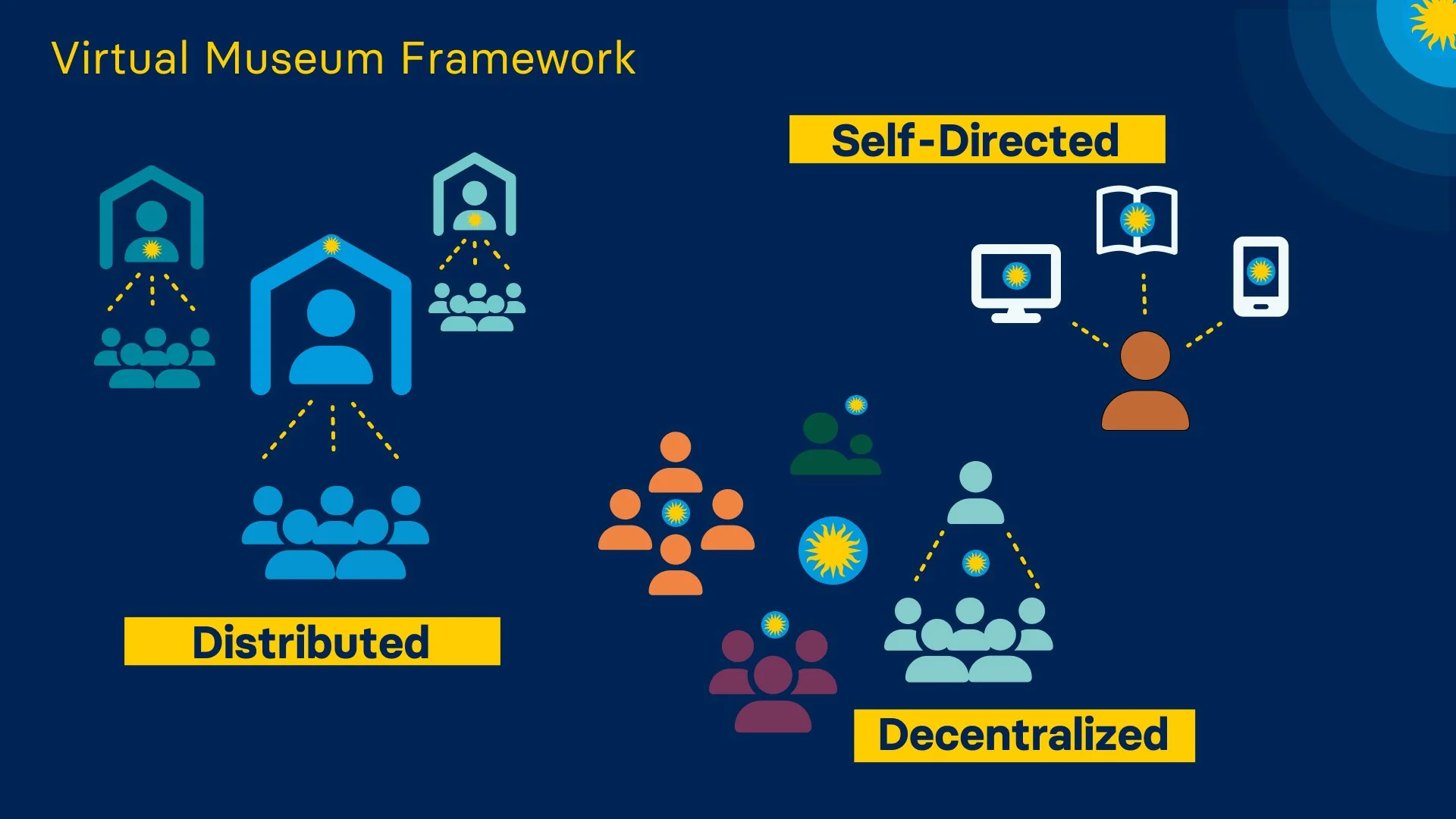
Excerpt from the Virtual Museum Framework